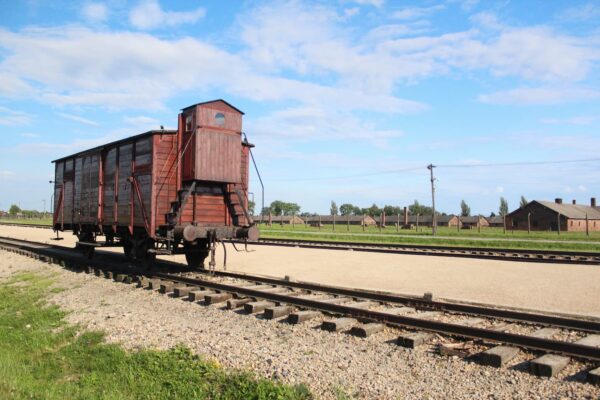
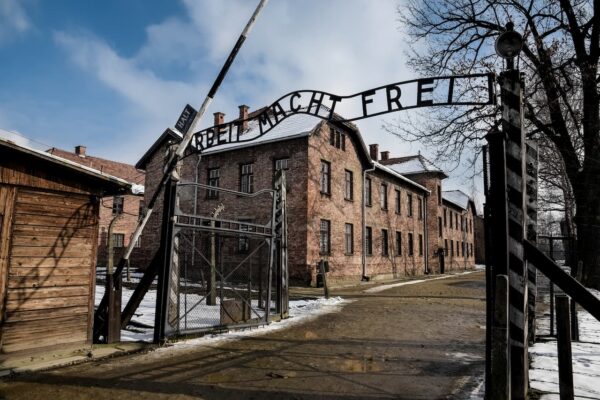
The Auschwitz I and Auschwitz II – Birkenau concentration and extermination camps are symbolic sites of Holocaust remembrance.
Atrocities were committed here that mere words cannot restore: from executions, either by firing squad or in gas chambers, to the extreme living conditions of the deportees. Unfortunately, not even children were spared from such atrocities.
Of course, it was mainly young Jews who suffered, but Roma, Polish, and Slavic children were also killed by the Nazis: an estimated 230,000 were those who reached Auschwitz, almost all of whom died in the gas chambers, or as a result of the living conditions inside the camp.
In this article we will go together to discover these sad stories related to the youngest Auschwitz prisoners and understand the significance of the room in Block 6 dedicated to them.
But beware! Before we go any further, let me give you a valuable piece of advice: to get the most out of the teaching that the museum-camp offers, it would be ideal if you reserved an experienced guide to accompany you during your visit. Only in this way will you be able to have a truly complete experience, linking directly to each block of Auschwitz the stories of the prisoners and the historical insights that the expert guide will provide.

Ticket to Auschwitz-Birkenau (skip the line)
Purchase online. Choose the time of your choice. Visit the prisoner barracks, infamous gas chambers and crematoria on your own.
You can cancel for free up to the day before your visit.
Table of Contents
The children’s room at Birkenau

Shoes that belonged to children, Auschwitz II concentration camp.
Photo ID 155031944 | Auschwitz © Nomadsoul1 | Dreamstime.com
Today, room number 4 in block 6 is entirely dedicated to children. They were mostly Jews and Roma, but also Poles and Russians.
Almost all of them were immediately exterminated inside the gas chambers, many others later died from the conditions in the camp, from hardship and disease.
Photographs of the little ones interned at Auschwitz have been reproduced in this room; you will also be able to see photos of those few, very young ones rescued by the Soviets.
The tragic story of the children deported to Auschwitz-Birkenau

Room for mothers with children in Auschwitz – Birkenau concentration camp.
Photo ID 140283191 | Auschwitz © Szymon Kaczmarczyk | Dreamstime.com
The fate of deported children
At the liberation of the camp, there were only 700 living children and adolescents.
Most of all those who arrived died in the gas chambers or against the Wall of Death, still others because of the poor conditions in which they lived, or during the infamous “death marches. “
Considering the nature of the camp, i.e., labor and extermination, the presence of children was not “useful” for the purposes of Auschwitz. So, the youngest ones brought in, essentially came only to die.
They almost always arrived at Auschwitz together with adults in the same convoys, only to be separated from their parents once at the gates; however, there were some transports dedicated only to children such as the one in the Białystok ghetto.
Of the 230,000 children deported to Auschwitz, almost all were of Jewish origin; moreover, almost all were taken directly to the gas chambers.
Fewer than seven thousand teenagers were spared, either because they showed more years than they had, or because there was a special need for labor and therefore they were needed for forced labor.
From the summer of 1943, other children had a chance to survive (about 3,000) but only because they were needed for Josef Mengele‘s experiments.
Medical experiments on children

Barrack 10 where experiments on children were carried out.
Photo ID 177849637 | Auschwitz © Wojciech Grabowski | Dreamstime.com
The children selected by Mengele for his experiments were considered lab rats.
Initially, the brutal doctor focused on ethnic Roma, and only after the liquidation of the family camp in 1944 did he shift his attention to Jewish children.
Placed in barrack number 10 in slightly better conditions, with sufficient food rations, they were, however, victims of atrocious experiments, in which they often found death.
Mengele focused particularly on infants and twins. Some of Mengele’s cruelest experiments consisted of injecting substances into children’s eyes, or inserting pins inside their heads.
Other cruel examples were theinjection of diseases to study their effects on the bodies of guinea pigs.
The “Gypsy Children’s Camp” (Zigeunerlager)
There were about eleven thousand Roma children and adolescents deported to Auschwitz.
Initially they were concentrated in the camp for Roma families, however, shortly thereafter, Mengele ordered the construction of a special camp, namely the Kindergarden.
The purpose of this place was to facilitate the experiments of the terrible Auschwitz doctor.
Because of the terrible hygienic and sanitary conditions, countless children died from the diseases, sometimes at the behest of Mengele himself, who injected them to test their effects.
Of the ethnic Sinti children who survived such anguish, only a few made it out of Auschwitz-Birkenau, as they were almost all exterminated between May and August 1944, when the Nazis liquidated the camp for Roma families.

Ticket to Auschwitz-Birkenau (skip the line)
Purchase online. Choose the time of your choice. Visit the prisoner barracks, infamous gas chambers and crematoria on your own.
You can cancel for free up to the day before your visit.
Auschwitz-Birkenau children: how to visit the museum-camp

Room for mothers with children in Auschwitz – Birkenau concentration camp.
Photo ID 140283197 | Auschwitz © Szymon Kaczmarczyk | Dreamstime.com
To book a visit to Auschwitz you will only need to reserve free admission to the camp-museum. However, we recommend that you visit Auschwitz with an experienced escort and priority entrance to avoid the long lines.
We also advise you to book in advance to secure a guide in your own language and, most importantly, we suggest that you carefully choose the best time for a comfortable visit: to do so, consider the cold weather in winter and the presence of many tourists in summer.
The winning choice could be an intermediate season, and possibly avoid weekends, which are the most popular days.
If you want to learn more, or if you are ready to book, click here.
Children in Auschwitz: Frequently asked questions
The children inside the camp had no real use, so most of them were exterminated as soon as they arrived at Auschwitz. Some teenagers, however, managed to save themselves by pretending to be adults. Only a few young inmates were spared: many children of Sinti ethnicity (but only until 1944), mostly because they were used by the doctor Mengele for his experiments. Or the so-called “order-bearers,” or children assigned to individual camp personalities, usually because they could speak German. Their job was to communicate orders given by the protector to whom they were assigned, a camp authority who had the power over them to decide when to eliminate them.
Today room number 4 in block 6 is entirely dedicated to children. They were mostly Jews and Roma, but also Poles and Russians. Almost all of them were immediately exterminated inside the gas chambers; many others later died from the conditions in the camp, from hardship and disease. Photographs of the little ones interned at Auschwitz have been reproduced in this room; you will also be able to see photos of those few, very young ones rescued by the Soviets.
Yes, it is possible to do so since Auschwitz has no age limit. However, it is advisable to properly prepare the little visitor so that he or she can learn as much as possible from the visit without being upset by it. In this regard, we recommend that you take a look at our dedicated article.
It is important, first of all, out of respect for the people, very young people, whose lives were denied. In addition, it is also good to understand their stories because they allow us to understand the Nazi mentality of that period: the contempt for ethnic groups considered inferior, which did not loosen even in the face of small, defenseless children.
Auschwitz and children: conclusions
We have come to the end of our article. We have seen together the story of the children of Auschwitz-Birkenau and their sad fate.
In addition, I have answers to frequently asked questions related to the conditions of the youngest internees inside the camp.
However, should you still have questions, please feel free to leave us a comment below.
But remember: in order to experience your visit to the fullest and not miss a single piece of historical information about the grim children’s room, it is highly recommended that you enlist the help of an experienced guide.
Only then will you be able to know everything there is to know about this place steeped in solemnity, the most important concentration and extermination camp, a living testimony to what should never be forgotten!

Ticket to Auschwitz-Birkenau (skip the line)
Purchase online. Choose the time of your choice. Visit the prisoner barracks, infamous gas chambers and crematoria on your own.
You can cancel for free up to the day before your visit.