

Want to find out the true story of Europe’s most infamous concentration and extermination camp and want to arrive prepared? You’re in the right place! In this article we will look at everything behind one of the central sites in the history of the Holocaust.
As you continue reading, in fact, you will discover all the main facts related to the history of the Auschwitz concentration camp, from its creation to its liberation on January 27, 1945.

Ticket to Auschwitz-Birkenau (skip the line)
Purchase online. Choose the time of your choice. Visit the prisoner barracks, infamous gas chambers and crematoria on your own.
You can cancel for free up to the day before your visit.
Table of Contents
Brief history of the Auschwitzconcentration camp

Entrance to Auschwitz – Stock photo. ID 23218587 © Deepgreen | Dreamstime.com
The Auschwitz concentration camp was built by the Nazis in 1940. The SS thought of exploiting the grounds of an old Polish artillery barracks: it was Heinrich Himmler himself, SS commander, who identified the right place.
From the very beginning Poles and political prisoners were transported here, later deportations of Jews from all over occupied Europe began.
Nazi fury also fell on the local population, guilty of seeing and hearing valuable information that should not leak out, sometimes accused of providing support for escape attempts.
Following Heinrich Himmler’s visit to the concentration camp in 1941, it was decided to expand the complex: this was the birth of Birkenau.
In 1942, the extermination of the Jewish population inside the gas chambers began, and so began the dreadful “selections”: SS doctors review the deportees arranged in the camp square. They will be the ones to choose those to be sent to the gas chambers.
Many former inmates who survived the extermination will recount that they often noticed the presence of Josef Mengele at these selections, the doctor infamously known for his terrible experiments on prisoners, even children and infants.
In fact, some prisoners do attempt uprisings and escapes: in June of this year, some 350 inmates try to escape, but only seven of them succeed while the others die.
In the meantime, the Germans set up many camps subordinate to the main one with the purpose of supporting industries through slave labor of prisoners.
At the same time, however, the first reports of these barbarities begin to leak out: the Polish resistance sends reports to the central government momentarily exiled in London.
Anti-Nazi Germans such as Edward Schulte, an important industrialist, who will inform the Allies of Himmler’s presence during an extermination by gas, also collaborate in this leak.
But the first direct news for the Allies came in 1944 when, with the changing course of the war confrontation, they began to fly over Germany, and in May of this year photos were taken of Auschwitz in which both the gas chambers and the smoke from the crematoria could be distinguished.
As the Soviets advance, the Germans intensify extermination operations and witness major mass uprisings: on October 7, 3 Nazi soldiers are killed, but the rioters will all be taken to the gas chambers.
Now almost at the end of the war, in January 1945, the Germans begin to evacuate the camps with the notorious “death marches” in which prisoners are forced to march nonstop, in the cold, debilitated, with the danger of being executed should they fail to keep up the pace.
With the Soviets now at their doorstep, the Nazis blew up the gas chambers and ovens of Auschwitz-Birkenau with the hope of eliminating all traces of the genocide, and then made their escape.
On January 27, the Russians liberated the concentration and extermination camp with about 7,000 prisoners still inside.

Ticket to Auschwitz-Birkenau (skip the line)
Buy your ticket online. Choose the time of your choice. Visit the Auschwitz-Birkenau death camp, prisoner barracks, infamous gas chambers and crematoria on your own.
You can cancel for free up to the day before your visit.
Auschwitz-Birkenau: in-depth history

ID 239172174 © Francesco Valenti | Dreamstime.com
The Auschwitz concentration camp was built in 1940 for the purpose of creating a vital place to implement the final solution.
In fact, more than 1.3 million prisoners were deported here: most were Jews and almost all of the inmates found death.
Many were exterminated through the gas chambers, others died from the forbidden labors and conditions or from executions by the SS.
The camp remained active until 1945, when the Soviets liberated Auschwitz and the few survivors.
Himmler himself took an interest in the place, who also ordered its expansion through the construction of Auschwitz II – Birkenau.
There were several incidents of revolt and escape attempts, such as the one on July 6, 1940 by Tadeusz Wiejowski, the first to succeed. However, only 150 prisoners managed to escape from this hellish place.
The local population living near the camps suffered Nazi harassment as they were accused of assisting the prisoners in their attempts; in addition, a Polish resistance formed across the nation and sent word to the central government in exile in London.
Some anti-nationalist Germans also collaborated with the Allies, providing important information about Auschwitz that the Germans were adept at keeping as secret as possible until 1945.
The choice of Auschwitz and its foundation
It is well known that the outbreak of World War II is traced back to the Nazi invasion of Poland in September 1939.
By the end of the year, considering the large number of Poles arrested, the need to establish a concentration camp became apparent.
It was Himmler himself who identified the suitable area, in Oświęcim, starting from the grounds of an old Polish artillery barracks.

Aerial view of the Auschwitz I camp. Photo ID 163749540 © Oleksandr Tkachenko | Dreamstime.com
In June 1940 the first deportations began, originally consisting almost only of Poles and a few Jews.
After a few days, the population living near the camp was also affected by Nazi violence through assaults and arrests with the aim of avoiding interference and to prevent them from facilitating prisoners’ escape attempts.
Not even a year after construction began, Auschwitz was already showing itself for the hellish place it was.
The extermination project

Gas chamber in Auschwitz concentration camp I: Photo ID 153201578 | Auschwitz © Jaroslav Moravcik | Dreamstime.com
In 1941, Auschwitz received its first official visit from Heinrich Himmler, the SS commander. One of the orders that followed the inspection was to expand the camp and, as a result, provide prisoners for the construction of industrial plants.
Meanwhile, at Auschwitz, the first executions and mass killings through the use of gas began; in addition, the camp also began to house non-Polish prisoners.
As the Nazi death machine was being perfected, Himmler’s plan also took shape, withthe construction of the second camp, Auschwitz II – Birkenau on the territory of the nearby and destroyed Brzezinka.
In addition to the first use of the gas chamber, 1941 was also the sad year of the first executions at the wall that would be named the “Wall of Death.” In fact, the first execution took place in a “temporary” gas chamber: two farms near Birkenau.
But it would be from 1942 that the name of Auschwitz would become inextricably linked with the Holocaust: the systematic extermination of the Jewish population would begin.
In fact, starting in March nearly 70,000 Jews from France and about 27,000 from Slovakia arrived at the camp. The second camp, Birkenau, officially went into operation, and gas chambers began to be used here as well.
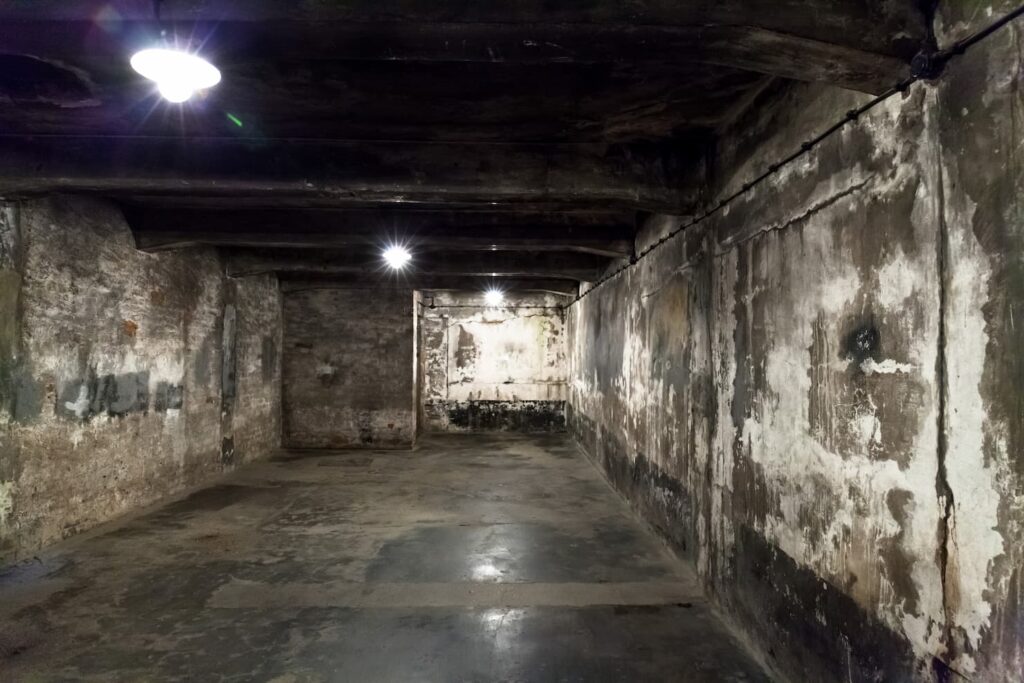
Auschwitz gas chamber: Photo ID 84296726 | Auschwitz © Nortophoto | Dreamstime.com
1942 brought with it the beginning of another sad practice: selection at the entrance. Prisoners were rounded up in the camp square, and “selected” by German doctors: once this stage was completed, the chosen deportees were led to the gas chambers and once eliminated, to the crematoriums.
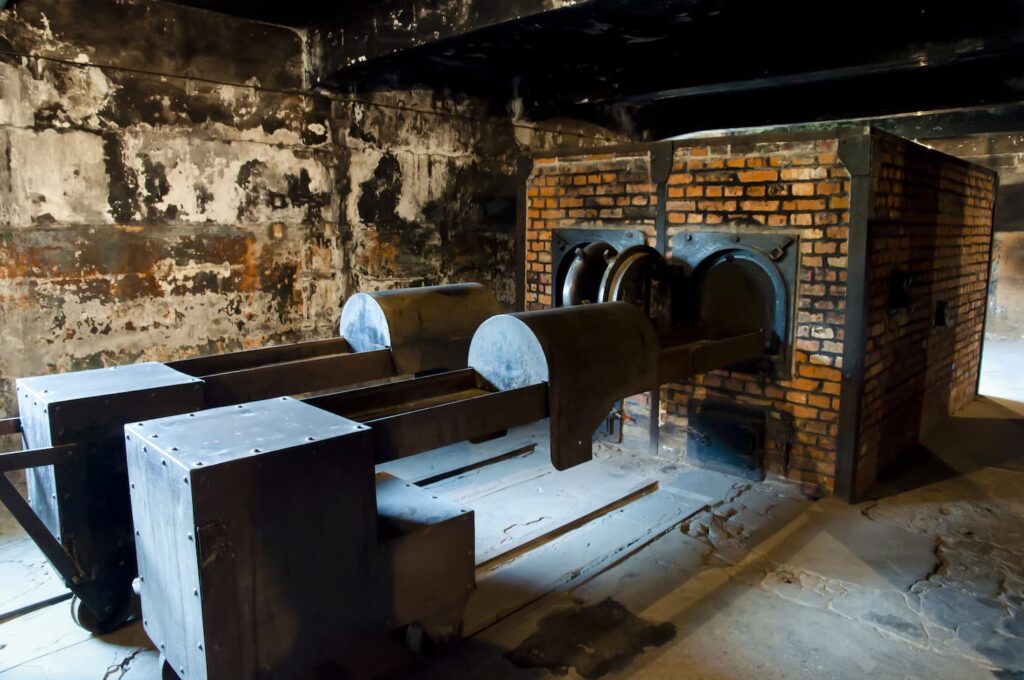
Auschwitz crematoria: ID 90458246 | Auschwitz © Adwo | Dreamstime.com
Those who arrived at the death camp were selected by doctors in the same way, and those who were deemed fit for work were marked with a number, thus also losing their names.
Among the SS doctors who selected prisoners, it is worth mentioning Josef Mengele. Very many deportees who survived the Holocaust, in fact, will recall that Mengele was almost always present during these moments.
The sadistic doctor is remembered for his insane practices carried out in Block 10, the Auschwitz hospital. Here, Mengele conducted pseudo-scientific experiments on children, infants, patients with special conditions such as those with dwarfism, twins and more.

Barrack 10, a place where experiments on children were carried out. Photo ID 177849637 | Auschwitz © Wojciech Grabowski | Dreamstime.com
It subjected some prisoners to real tortures such as castration, hypothermia tests, injection of diseases or even actual murders to dissect the bodies.
On children he carried out special studies involving injection of substances inside the eyes, insertion of pins and blades into the skull and other barbarities.
In October 1942, the Auschwitz III – Monowitz, Buna dependency camp was established.
Until ’44 , 47 other camps would come into being, all of them subsidiaries of the main one and within which prisoners were forced into forced labor for German industries.
From 1944, as the Allies advanced into Germany, the first aerial photos of the camp also began to appear, however, this was the year the Nazis increased executions in the gas chambers to complete their horrific “Final Solution.”
The liberation of Auschwitz
Since November ’44 , mass extermination in the gas chambers has stopped: the Germans know that both the Americans and the Soviets are closing in, and they begin to think about hiding the traces of the crime committed.
On January 17, 1945, the infamous Death Marches began , by which the SS evacuated the camps. Tens of thousands of inmates were forced to march to other concentration camps not exposed and close to Soviet conquest such as Auschwitz.
The marches moved in two directions: one toward Gliwice, the other toward Wodzislaw. During these long marches, SS soldiers cold-bloodedly killed deportees who could not keep up, which was common considering the poor conditions they were in and taking into account the unsuitable clothing for the extremely harsh winter temperatures.
An estimated 15,000 inmates died during these inhumane death marches.
Once the prisoners reached their destination, they were crammed onto freight trains, always in the cold and in inhumane conditions, so that they could be sent to concentration camps in Germany where they were thought to remain safe from Russian invasion. Also during this rail transport, a great many prisoners would find death.
The following week the Germans destroyed the gas chambers and crematoria at Birkenau by blowing them up so as not to let the Soviets know what those camps actually were. On January 27, Stalin’s troops entered Auschwitz freeing about 7,000 prisoners.
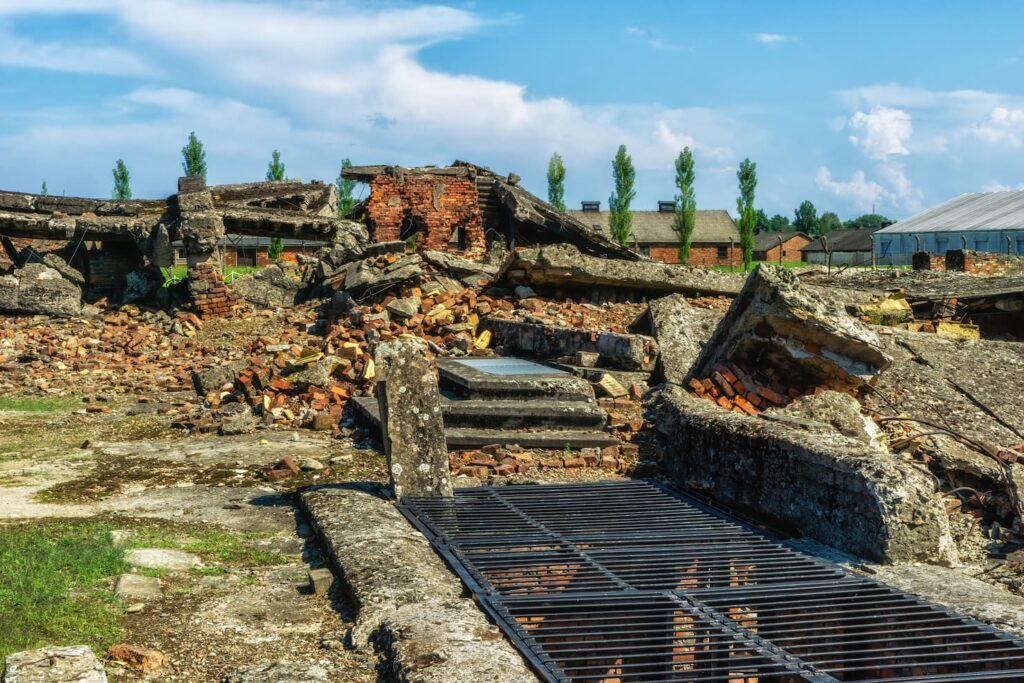
Ruins of a destroyed gas chamber, Auschwitz II-Birkenau death camp. Photo ID 271443977 | Auschwitz © Atosan | Dreamstime.com
A place of remembrance: the Auschwitz-Birkenau museum
As soon as the war ended, it was immediately understood that what had happened at Auschwitz was something tremendously serious. It was also understood that it was necessary to pass on that horrible experience in order to raise awareness for future generations.
Thus, as early as 1947, the first exhibition in the barracks was inaugurated. It happened in USSR-annexed Poland, and the exhibition was organized with the assistance of former prisoners.
In the 1950s, a program was created to renew the exhibition and it was decided to involve all nations that had had at least one victim there.
Exhibitions were opened within the site, and in 1979 Pope John Paul II held a mass here.
Respect zones were established around the Auschwitz and Birkenau areas; in addition, the Auschwitz International Memorial to the Victims of Nazi-Fascism was inaugurated in 1967.

Entrance to the Auschwitz museum. Photo ID 14775698 © Ckchiu | Dreamstime.com
Inside the museum-camp are now national exhibitions, most of which are constantly being renewed.
Four films have also been filmed inside Auschwitz, again with the aim of disseminating information and keeping memory alive; Spielberg, however, was denied the right to film some scenes from the world-famous Schindler’s List.
To conclude, the 50th Anniversary of the Liberation of Auschwitz was organized in 1995, which was attended by many former deportees.
Thus, the following year, Germany chose the date of January 27 as a day of remembrance, making it coincide with the date of the liberation of the camp.
Ticket to Auschwitz-Birkenau (skip the line)
Purchase your ticket online. Choose the time of your choice. Visit the Auschwitz-Birkenau death camp, prisoner barracks, infamous gas chambers and crematoria on your own.
You can cancel for free up to the day before your visit.
History of Auschwitz: Frequently Asked Questions
The Nazis considered building Auschwitz as early as 1940, shortly after Germany invaded Poland. This need became apparent in view of the very high number of Poles arrested during the occupation.In fact, initially they were primarily the ones deported to Auschwitz although, from early on, Jews were also brought here.The first deportations began immediately, in June 1940 and then intensified more and more and saw Jews from all over occupied Europe predominantly arriving.The following year, in order to intensify the extermination operations and support for German industries, the Nazis also built the second camp, namely Auschwitz II – Birkenau, following the order of the SS commander, Himmler.This second camp was also equipped with barracks, gas chambers and crematoria and later with a railroad yard connecting it to the main camp.
The main commandant of Auschwitz was Rudolf Hoß, the one who used to remind victims that the only way out of the camp was through the oven. He was commander until 1943 and died by hanging in 1947 where the Auschwitz International Monument in Memory of the Victims of Nazi-Fascism now stands.In 1943, Arthur Liebehenschel took his place and remained in charge until May of the following year; he too died by hanging in 1948. Finally, the last commandant of Auschwitz I was Richard Baer, who remained in charge until the liberation of the camp by the Soviets. He managed to escape and remained a fugitive until his arrest in the 1960s. As for Auschwitz II-Birkenau, however, the commanders were first Hartjenstein (who died in prison in 1954) and then Josef Kramer, who was also hanged in 1945.
Auschwitz was liberated on January 27, 1945, by the Soviets, who entered the compound in the morning, although the SS had already largely cleared the camp
Approximately 1,100,000 people were killed at Auschwitz, most of them of Jewish origin and newly arrived at the camp.When the Soviets arrived at the camp, they liberated just over 7,000 prisoners, although a few escapees were later found in the surrounding areas. However, of these survivors very many died in the following days, some because they were too debilitated, some by suicide.
Conclusions
So here we have come to the concluding part of our article. We have taken an important historical tour together to learn about the main stages of Auschwitz.
We looked at its history, from the sad day of its creation to its liberation in January 1945. We discovered together how and why the camp came into being, and its evolutions over time, also understanding its diabolical inner workings.
I subsequently answered frequently asked questions, thus giving you the salient information about the history of Auschwitz-Birkenau.
Well, I would say that you now have everything you need to better plan your visit. However, if you still have any curiosities, please feel free to write a comment below.
To finish, I would like to remind you that if you plan to visit Auschwitz-Birkenau , it is very important to avail yourself of a guided tour if you decide to visit the camp-museum! Only with an experienced tour guide will you be able to understand every inch of the camp, accurately connecting each place to the events that took place there.
Moreover, this choice will make your visit more complete and thorough, giving you a more enriching and emotionally indelible experience.

Ticket to Auschwitz-Birkenau (skip the line)
Purchase your ticket online. Choose the time of your choice. Visit the Auschwitz-Birkenau death camp, prisoner barracks, infamous gas chambers and crematoria on your own.
You can cancel for free up to the day before your visit.
Cover photo: ID 23218587 © Deepgreen | Dreamstime.com
Sources:
- Auschwitz-Birkenau State Museum
Official site of the museum, provides historical details, visitor information and educational resources.
https://www.auschwitz.org/en/ - Encyclopedia of the Holocaust – United States Holocaust Memorial Museum
Offers a detailed overview of Auschwitz, including its history and role during the Holocaust.
https://encyclopedia.ushmm.org/content/it/article/auschwitz - Historia Ludens – Auschwitz
Academic portal that explores the history of Auschwitz through different perspectives, with insights and educational materials.
https://www.historialudens.it/component/tags/tag/auschwitz.html - Engram – The Architecture of Auschwitz
Academic article analyzing the architecture of the concentration camp, offering a unique perspective on its structure and function.
https://www.engramma.it/eOS/index.php?id_articolo=5152 - WeekNews – Auschwitz
Article reflecting on the memory of Auschwitz and the importance of historical testimony.
https://www.settimananews.it/societa/auschwitz/

