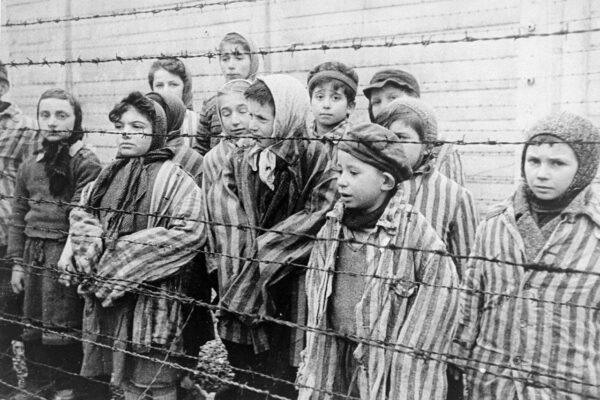
The figure of Liliana Segre is closely connected to that of Auschwitz, as she is one of the survivors of the Holocaust.
The woman has become a symbol of historical memory and civil resistance. She also fought hard for the memory of the Shoah to be kept alive, committing herself personally and spreading her testimony to younger people as well.
In this article we will discover together who Liliana Segre is, going through the main stages of her biography and learning about the dramatic testimony related to the terrible experience inside the Auschwitz camp.
Finally, we will learn about Segre’s commitment to reinforcing remembrance and memory related to the Shoah.
Table of Contents
Who is Liliana Segre: the true story of the senator who survived Auschwitz

Liliana and Alberto Segre – Public domain portrait print – Source Wikimedia Commons
Childhood
Liliana Segre was born in Milan in 1930 to an Italian family of Jewish descent.
Her mother died when she was only one year old, and the rest of the family experienced the tragedy of the Fascist racial laws of 1938.
Growing up in a secular family, it was only because of the Nazi-fascist onslaught that he became aware of his Jewish origins.
In December 1943, the Segre family tried to escape to Switzerland: repelled, they were later arrested.
Deportation to Auschwitz
On January 30, 1944, Liliana was deported to Auschwitz-Birkenau. Liliana Segre recounted how the SS and fascists filled prisoners with fists and clubs in order to load them as quickly as possible onto cattle cars.
Through her testimony, Liliana explained how the wagon was immediately bolted as soon as it was crammed with people: inside the wagon there was only a little straw and a bucket for their needs; it was in these conditions that they would face the long journey to Auschwitz.
As soon as she arrived at the camp she was immediately separated from her father, whom she never saw again. Liliana’s grandparents met the same fate, arrested shortly thereafter and killed as soon as they arrived at the death camp.
Upon selection Liliana was assigned the number 75190 and was forced into forced labor.
Only 13 years old, Segre recounted how the only way she could resist that life was through estrangement: only by ignoring as much as possible that impossible world in which she lived could she find the strength to go on.
So she tried not to get attached to anyone or make a habit, like so many others, of looking at a star in the night, to have a foothold to cling to outside the camp.
She survived every selection and even the cruel death march to Germany.
The liberation
She was among only 25 Italian children under the age of 14 who survived Auschwitz among the 776 deportees, liberated on May 1, ’45 by the Soviets.
Liliana returned home where she found only her maternal grandparents and an uncle. Reintegration into society was not easy, as she was deeply scarred by what she had suffered.
For a long time she preferred to keep silent about what the death camp was like: she too remembers not finding people willing to listen to her. It was not easy to find a way to tell, to be believed, to find those who were able to listen and try to understand.
After years of silence, however, also aided by contacts with other survivors, she decided to divulge her testimony and, step by step, she became one of the most important witnesses and symbols of Holocaust Remembrance.
Through her commitment and dedication, she spread her testimony and engaged especially with the younger generation so that they would truly understand what the Holocaust was about is the importance of fighting indifference and keeping the memory alive.
Liliana Segre has also become a symbol of peace because she has always made herself the bearer of a message of forgiveness towards her executioners despite her full and deep awareness of what happened.
She accepted to live, despite the death she had to suffer: she had three children and became a living monument of Remembrance.
Liliana Segre today

Liliana Segre – Photo by Unipavia on Flickr
Considering the importance of her commitment and her role in historical memory, on January 19, 2018, the year in which the 80th anniversary of the racial laws fell, she was appointed senator for life by Italian President Sergio Mattarella.
In parliament, she has always stood up for inclusive laws, fighting against hatred, racism and intolerance.
Her first speech in the Senate was in June of the same year she was appointed, and it was a valuable speech in which she recalled the racial laws and her experience as a deportee.
Throughout her life, Liliana Segre was a bearer of values and virtues that she zealously worked to spread.
Obviously, her most important interventions are related to the Shoah: her testimony was invaluable in learning about what Auschwitz was and so that the memory would be kept alive over the years.
She also contributed to the writing of books about the concentration camp and its history, leaving something lasting for generations to come as well.
But Segre has also intervened in the social and human field in a broader sense: she has often been in the forefront against hatred and racism, becoming a virtuous example of civic and social engagement.
For example, she participated alongside the Libera association in numerous initiatives against the Mafia in Italy and around the world.
Liliana Segre’s most important aphorisms
Liliana Segre, Holocaust witness and life senator, is a voice that embodies historical memory and the value of resilience.
Her words, often incisive and poignant, go beyond a simple biographical account, becoming aphorisms capable of inspiring generations.
One of his most famous thoughts is, “Cultivate memory as a vaccine against indifference.” With this phrase, Segre recalls the importance of keeping alive the memory of past atrocities to prevent their recurrence.
Likewise, she strongly states, “Indifference is more culpable than violence itself,” emphasizing how silence and apathy can fuel the worst injustices.
Another significant aphorism is related to the inner strength needed to overcome pain: “I am alive to witness, not to hate.” With these words, Liliana Segre transforms the tragedy of her experience into a message of hope and love for life.
Finally, she calls for personal responsibility: “Do not say ‘I have something to do with it.’ We always have something to do with it.” This simple but most powerful phrase recalls the duty of every individual to act against injustice, without turning away.
Liliana Segre Auschwitz: Frequently Asked Questions
Liliana Segre is a Holocaust survivor, having been deported to the Auschwitz-Birkenau concentration and extermination camp. Once she returned home, after an initial period of silence, she spread her testimony and became an activist for historical memory. Her valuable work has expanded by going against all hatred, racism and intolerance in general, in addition, of course, to her great efforts against anti-Semitism. For her interventions and her educational figure, in January 2018 she was appointed a senator for life in Italy by Italian President Sergio Mattarella.
Liliana Segre was deported to Auschwitz at the age of 13. As soon as she arrived at the concentration camp, she lost her father, who soon died inside the camp. The rest of the family was also exterminated in the Lager, so much so that upon returning to Italy she would find only her maternal grandparents and her uncle. The very young Liliana struggled to survive the harsh conditions of Auschwitz, trying to abstract herself from the world she was in in order to move forward.
Liliana Segre is a symbol of resilience and civic engagement against racism, hatred and indifference, themes central to her public activity. She is also important because she has continued to pass on her testimony, especially to new generations, so as to keep alive the memory and remembrance of what the Holocaust meant.
Liliana Segre’s story is told in several books, including “Memory Makes You Free,” co-written with Enrico Mentana, which contains her testimony and account of her tragic experience.
Conclusions
So here we have come to the concluding part of our article on Liliana Segre. We have seen together Liliana Segre’s role, her social importance, and her commitment in the civic sphere against hatred, racism, and above all, indifference.
We read her biography, the account of her tragic deportation and experience inside Auschwitz, her return to Italy and the commitment that led her to be appointed senator for life.
Finally, I have finished by answering the most frequently asked questions related to this topic; however, should you have any other doubts or curiosity, please feel free to leave a comment below.
If you would like to find more information about Auschwitz, I invite you to visit our website where you can read historical articles about the infamous concentration camp. If you wish, you can also find articles with useful information for organizing your visit to Auschwitz-Birkenau.
Now that the last survivors are leaving us, a visit to Auschwitz becomes even more necessary because as Liliana Segre herself said , “Indifference is more culpable than violence itself. It is the moral apathy of those who turn away: it happens even today toward racism and other horrors of the world.”