

Given the importance of the historical record of the Auschwitz museum-camp, any means has always been welcome to pass on what the Holocaust was and meant.
Cinema, therefore, has also come to terms with Auschwitz, seeking to bring many stories to the big screen with the goal of passing on the narrative of memory.
The fact that cinema deals with the Shoah has a very important historical value first of all, as it disseminates in a broad and accessible way to the general public what actually happened in Europe in the 1930s and 1940s.
But it also has an important educational value, because it really allows everyone to become informed, to know, to understand, even those most inattentive on the subject, those who do not read willingly free and especially the youngest, who are more inclined to follow the plot of a film rather than a long book or documentary.
In this article you will read an overview of the importance of films centered on the theme of Auschwitz, and we will provide you with a list of the most popular and critically and publicly acclaimed ones.
For an even more emotionally impactful visit, it may be productive to see some films in advance that can introduce stories of the prisoners or give an initial idea of life inside Auschwitz.
Table of Contents
The best films about Auschwitz and the Holocaust: the definitive list
As mentioned, Holocaust films have contributed and continue to this day to spread the narrative of the Holocaust and keep its memory alive.
So many countries and so many filmmakers have contributed, each addressing the topic in his or her own way.
Thus, there are films from productions of a variety of countries: in this article we are going to discuss those considered “Indispensable,” great classics of the Holocaust theme, to be seen at least once in a lifetime, those focused specifically on Auschwitz and also the most important ones with Italian direction.
Indispensable classics

Oskar Schindler (Liam Neeson) in a scene from the film Schindler’s List – Screenshot of the film Schindler’s List personally captured by Phyrexian, without making any changes.
Schindler’s List (1993) by Steven Spielberg
A truly well-received film that won a whopping seven Academy Awards!
Inspired by Keneally’s novel, “Schindler’s List,” it is based on the true story of Mr. Oskar Schindler himself. Set in Krakow in 1939 just before the outbreak of World War II, the film shows us the subjugated Jewish Poles after the German invasion.
Meanwhile, Oskar Schindler, taking advantage of the ban on Jews, begins to set up a business making pots and pans for the army, forging relationships with top SS leadership.
Business proceeds despite the city’s abuse of Jews, but the turning point comes when construction of the new concentration camp begins.
Schindler’s exploited workforce begins to be in short supply, just as the treatment of Jews worsens; the protagonist therefore decides to start producing ammunition and grenades, thus renewing SS support, all the while trying to hire more Jewish personnel, particularly the children of internees to preserve them.
As the Soviets approach, however, the elimination of all Jews with transfer to Auschwitz is ordered. Schindler then decides to buy off one by one the Jews who worked for him by negotiating with the SS commander, compiling a list of those he wanted to save.
A mistake, however, moves the train on which the women and children were traveling to Auschwitz. Schindler, informed of the incident, arrives at the camp and also bribes its commander, Hoß, managing to save them.
When the war is over, Schindler must flee to avoid capture by the Soviets, as he is a member of the Nazi party, but his former workers provide him with a list of signatures, one for each man saved, to show in case of capture.
In the finale, Schindler accuses himself of not having saved enough people, having initially squandered money; his accountant, a Jew, heartens him by explaining that he has done more than anyone else.
A distinctive feature of the film is that it is entirely shot in black and white except for four symbolic scenes.
Also appreciable is the fact that part of the proceeds was used by Spielberg to create a nonprofit organization that collects the video testimonies of more than fifty-two thousand survivors.
The Pianist (2002) by Roman Polanski.
This film is also based on a novel, this time autobiographical, of the same title, written by Polish composer Władysław Szpilman.
Film awarded the Palme d’Or at the Cannes Film Festival (2002) and three Oscars in 2003.
This story is also set in 1939 Poland, but this time the main character is a Polish pianist of Jewish descent named Władysław Szpilman.
The film opens right with the German invasion against Poland while the protagonist is playing, until a bomb goes off in the recording studio.
A few days later, in an occupied Warsaw, restrictions and harassment of Jews begin. Therefore, Władysław is fired from the radio station he worked for and is also forced to sell his piano after his family runs out of savings, until he is imprisoned in the ghetto.
Here he witnesses torture and summary executions, but everyone is merely trying to survive. On August 16, 1942, Władysław, with his family, is taken to the railway to be deported to the Treblinka death camp, but is saved at the last moment by a gendarme friend of his.
Alone, he tries to survive in the ghetto with makeshift jobs until a riot breaks out and he escapes and then goes into hiding aided by non-Jews.
After being discovered, however, a German officer who is aware of his abilities forces him to play Chopin. The German, impressed by his skill, decides to help and feed him over the next few months until the Soviets arrive and force the Nazi to flee.
Before escaping, however, he asks the pianist’s name without saying his own and gives him his coat.
One morning, hearing the Polish anthem echoing from a loudspeaker, Władysław emerges from his hiding place to find Polish soldiers.
In the meantime , the Nazi general is captured and asks a Polish ex-deputy to tell Władysław about him. When the war is over, the protagonist will go looking for the German, but there is no trace of him and it turns out that his name was Wilm Hosenfeld.
Films centered directly on Auschwitz

Meryl Streep in a scene from the film Sophie’s Choice – Screenshot from the film Sophie’s Choice(1982) captured by Errix
Sophie’s Choice (1982) by Alan J. Pakula.
Based on the novel of the same name by Wiliam Styron, it tells of an impossible choice before which a mother is placed.
Set in the United States in 1947, a young aspiring writer, Stingo, has left the Marines and his father’s farm to seek his fortune in New York City.
Here, he settles in Brooklyn in a rented room. Other tenants in the house are two Jews, a couple who often disrupt the young writer’s life: Sophie is an Auschwitz survivor, while Nathan is an intellectual obsessed with the Holocaust.
The protagonist thus comes to know a reality in which he had not participated, but which he begins to feel as his own. The couple reveals that they have not yet come to terms with the Holocaust, particularly Sophie, who says she supported the values of her father, a staunch Nazi and supporter of genocide.
However, as Jews, they suffered deportation, so Sophie and her two children were taken to Auschwitz, and here the woman was forced to make an impossible decision: to choose which son to save and which to consign to his fate.
Even inside the camp, Sophie compromises in order to survive, and for this, too, the past will haunt her forever.
The Son of Saul (2015) by Laszlò Nemes.
Winner of the Grand Prix prize at the Cannes Film Festival and the Oscar for best foreign film, it tells of an uprising that actually took place inside Auschwitz.
The main character is a Jewish-Hungarian Sonderkommando, Saul Ausländer, a stoic worker inside the camp and seemingly apathetic to the ugliness he witnesses.
Everything changes, however, when Saul hears of a revolt between the Sonderkommando Abraham and Oberkapo Biederman.
The idea is to bring out pictures taken with a camera seized from the deportees to show the world the conditions of the internees.
The riot is sparked when the prisoners discover that Biederman and his unit have been killed, so Saul escapes during the riot along with other prisoners.
Italian films about the Holocaust

Screenshot of the film La vita è bella directed by Roberto Benigni
Life is beautiful (1997) by Roberto Benigni.
Film that won three Oscars, the Cannes Grand Prix, 9 David di Donatello, 5 Nastri d’argento and other awards.
It offers a particular view on the Holocaust through a mixture of drama and comedy. The main character is Guido, an Italian Jew deported by the Germans along with his wife Dora and son Joshua.
Once interned, Guido tries hard to make the experience livable for his son, whom he hides from the sight of the Nazis after saving him from execution.
He makes him believe, in fact, that he is in a points game where the prize consists of a real tank: being seen by the Germans carries penalties.
So Joshua, though sometimes doubting and sometimes bored, plays along and manages to hold out until the Americans liberate the camp.
Some scenes turn out to be truly touching and poignant in their particular juxtaposition: for example, the blend of drama and romance in the scene in which Guido manages to greet his wife through the camp microphone with his “Good morning princess,” or the effectual blending of comedy and tragedy, such as in the scene in which Guido pretends to translate from German the rules of the game for his son Joshua, while in reality the SS soldier was explaining to the prisoners how to survive and of the forced labor they would have to perform.
Finally, memorable is the concluding scene in which Joshua finds his mother again, and greets her happily because he believes he has won by finding himself on an American tank.
Jonah Who Lived in the Whale (1993) by Roberto Faenza.
Based on an autobiographical novel by Jona Oberski, entitled: “Childhood Years. A Child in the Lagers.”
Jona is a Jewish child of just 4 years old who faces the tragic deportation that, after several steps, will lead him to Bergen-Belsen.
The little boy suffers all kinds of abuse and anguish until the evacuation of the camp, following which Jona and his mother are forced to wander through German territories on a train until liberation by the Soviets.
While Jona’s father had already died in the camp, her mother dies instead in the hospital due to too much psychological pain she suffered.
So Jona returns to his Amsterdam, adopted by a family of old friends, where he will become a scientist.
Major documentaries

Cover of the documentary Shoah (Claude Lanzmann) – image by Film Fan(talk | contribs)
Shoah (1985)
Monumental documentary by Claude Lanzmann on the memory of the Holocaust.
Lanzmann interviews survivors and also former SS men and locals where the camps stood.
There is no intention on the author’s part to provide easy immediacy, but he wants to provide in a raw and direct way what it was like for those who participated in those follies.
The term Shoah for the title, of Hebrew origin, was chosen precisely because of its untranslatability: it was from here on that studies of the word proliferated and it was so widely used.
Auschwitz (2011)
Documentary by Uwe Boll, characterized by a raw and direct approach.
At times disturbing, it shows in a truly forthright manner the sadism and perversion of life inside the most notorious of the Nazi death camps.
Movies about Auschwitz: Why watch movies about concentration camps?
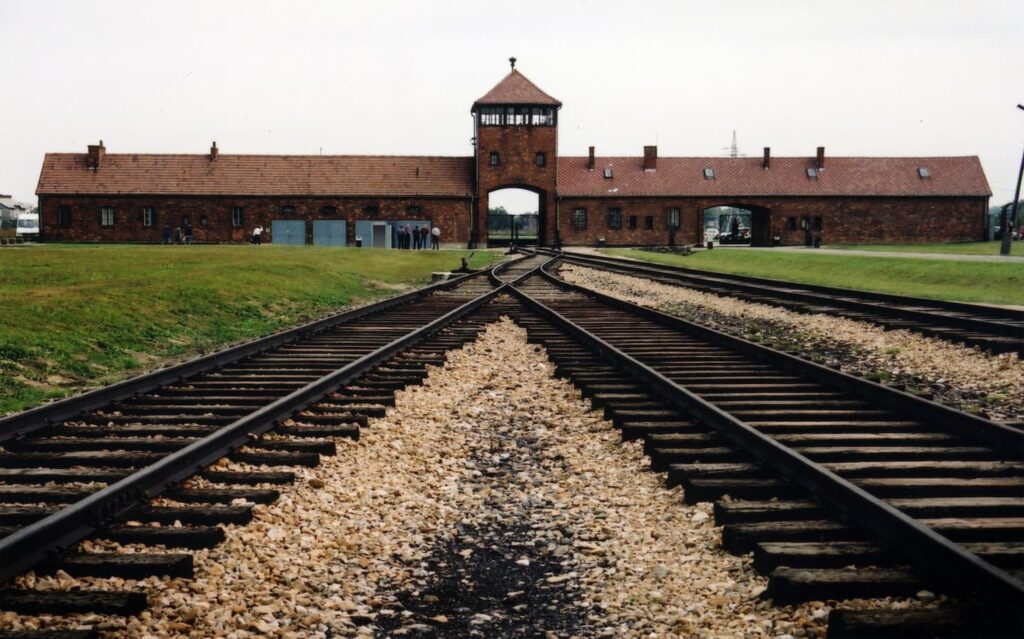
ID 239172174 © Francesco Valenti | Dreamstime.com
Films about concentration camps, and more generally about the Holocaust, are a very important testimony indeed.
Cinema, you know, has always had a great hold on a very wide audience, from the very young to the very old, regardless of the level of culture.
Moreover, it is to such a degree that the emotional impact of a film is so strong that it sometimes allows one to get a better idea of what is being talked about than a book.
It is thus that, by seeing scenes on the big screen, the audience finds it easier to understand what really happened and is naturally urged to greater emotional participation.
It is also for these reasons that cinema has taken on an important educational role with a strong historical and cultural value: it is also thanks to films that the account of what the Shoah was has spread widely and that its memory continues to be kept alive.
Films are also used as a tool to teach new generations about history: what happened, what it meant, and the importance of continuing to keep its memory alive by learning from those terrible human mistakes.
It often happens, in fact, that in various parts of the world films related to the Holocaust are shown in schools precisely to teach and raise awareness, especially on Holocaust Remembrance Day, but also without specific anniversaries.
Frequently asked questions
Schindler’s List is one of the best known, but there are also other impressive films such as The Son of Saul or the Italian “Life is Beautiful.”
Yes, many films, such as Schindler’s List and The Pianist, are based on real events or autobiographies.
Claude Lanzmann’s Shoah and Uwe Boll’s Auschwitz are two of the best-known documentaries on the subject.
Many titles are available on platforms such as Netflix and Amazon Prime Video.
Auschwitz and cinema: Conclusions
Here we have come to the conclusion of our article. We have analyzed the importance of cinema in keeping Memory alive.
I mentioned the most important films related to the Holocaust and Auschwitz, and finally answered the most common questions.
Please also browse the rest of our site to learn everything you want to know about Auschwitz, because while film offers us great opportunities to learn and understand, nothing will ever be like observing the Auschwitz memorial with your own eyes.

