Are you thinking of visiting the Auschwitz concentration camp on your own and wondering if it is possible and how to do it? This guide is for you! In this article we will discover together the key information for planning a visit to Auschwitz-Birkenau on your own. By the end of the reading you will know exactly how to best explore the more than 40 square kilometers of museum-camp.
Warning To make the most of the experience, we strongly recommend booking your skip-the-line ticket in advance of your visit. Only in this way can you avoid long lines and be entitled to time-saving priority access.

Auschwitz-Birkenau: Self-Guided Tour + Transport
Buy online. Choose the time of your choice. Visit the prisoner barracks, infamous gas chambers and crematoria on your own.
You can cancel for free up to the day before your visit.
Table of Contents
- 1 Auschwitz Concentration Camp: Historical Background
- 2 How to reach Auschwitz-Birkenau on your own
- 3 Traveling to Auschwitz independently: useful info
- 4 Do-it-yourself tour of the Auschwitz-Birkenau concentration camp
- 5 Visiting Auschwitz on your own: Frequently Asked Questions
- 6 Complete visit to Auschwitz-Birkenau on your own: conclusions
Auschwitz Concentration Camp: Historical Background
Construction of Auschwitz began from May 1940 in an abandoned Polish artillery barracks.
Work was carried out by prisoners, who were forced to work at an inhumane pace and conditions under SS surveillance, with the aim of expanding the space allocated for the camp. The prisoners came from all countries occupied by Nazi Germany.
Indeed, the goal of this camp was not only the detention and exploitation of slave labor, but also the systematic extermination of entire population groups.
That is why Auschwitz, like many other camps, was equipped with gas chambers and crematoria.
Also in the camp hospital, in Block 10, experiments were carried out on prisoners, especially infants and twins.
Auschwitz-Birkenau, the second camp, was built by the Germans the following year for the very purpose of exterminating as many prisoners as possible and they used gas chambers until November 1944.
It is estimated that about 1.1 million Jews were deported here, in addition to 350,000 victims belonging to other ethnic groups, such as Sinti or Poles, as well as political opponents and, in general, people disliked by the regime.
From mid-January 1945, due to the approach of Soviet troops, the SS received orders to clear the camps: and this was yet another opportunity for the Nazis to perpetrate abuse and brutal executions.
On January 27, Soviet troops entered Auschwitz, liberating the survivors.
How to reach Auschwitz-Birkenau on your own

Auschwitz-Birkenau parking lot – Photo ID 162279418 © Robert309 | Dreamstime.com
To get to the Concentration Camp you have many options to choose from!
First, you can reach it from the two nearest cities with an airport, Krakow or Katowice, whether you prefer to travel by train, bus, car, or cab.
From Krakow you can leave from the central station by direct train for a distance ranging from 48 minutes to an hour and twenty minutes.
As for the bus, a journey of about an hour and a half will await you starting from the central bus station.
Do you prefer to travel independently? No problem!
With a journey half on a toll road you can reach the convenient parking lot near the museum-camp with a trip of about one hour and twenty minutes.
If, on the other hand, you wish to reach Auschwitz from Katowice, a shorter drive will await you: you will have arrived at your destination after just 45 minutes!
By train, on the other hand, you will be able to reach the museum-camp after an hour’s journey, to which must be added the waiting time for the connection between the first and second leg.
Finally, if you are planning to visit starting from Warsaw, you can reach your destination by car by traveling for about three and a half hours.
Do you prefer to travel by public transportation? It will be enough to reach Kraków and then move to the town of Oświęcim that houses the camp-museum, in which case the journey ahead will be a bit longer since Warsaw is about 370 km from the camp.
Auschwitz-Birkenau: Self-Guided Tour + Transport
Buy online. Choose the time of your choice. Visit the prisoner barracks, infamous gas chambers and crematoria on your own.
You can cancel for free up to the day before your visit.
Traveling to Auschwitz independently: useful info
The camp-museum is a historical site of monumental importance! If you wish to plan a visit to Auschwitz, it is good that you know some useful information to make the best arrangements.
First of all, inside the camp it is good to observe some rules of behavior since you have to respect the place and what it represents.
Comfortable shoes are recommended and, if visiting in the winter months, it is a good idea to cover yourself adequately; it is also good to avoid garish or too short and low-cut clothes.
Also remember that bags or backpacks no larger than 30x20x10 cm may be brought in.
As for children, it is not recommended for children under the age of 14 to visit because of the strong emotional impact of the places in question; however, it is not forbidden, so each parent will, of course, assess what is best for their children.
With the exception of block 4 and 11, you will be allowed to take photos and videos but strictly without flash.
Another essential information you need to be aware of is that you must necessarily make the visit reservation online.
If you are traveling independently, this free reservation will be sufficient for you to gain access, but if you prefer you can also request an in-house educator (a paid service).
Renting headphones and watching the documentary on the liberation of the camp also require payment.
You will be able to take advantage of the english-speaking guides each day, but beware: if you do not make a reservation, availability may end as places with chaperones are limited.
I strongly recommend that you take advantage of these options because it is the only way you can have a truly complete experience and make the most of this meaningful experience.
Other valuable information you should be aware of is, of course, the museum’s opening hours: you will find it open every day except Christmas, Easter and January 1.
The opening hours of the camp vary from month to month:
- December: 8 a.m. to 2 p.m
- January and November: 8-15 a.m
- February: 8-16
- March and October: 8-17
- April, May and September: 8-18
- June, July and August: 8-19
Keep in mind that the time listed is not closing time, but rather the last time you are allowed to enter: should you choose to enter at the end of the day, you will be able to stay inside the site for no more than an hour and a half.
However, we strongly recommend that you dedicate at least three hours for a full visit.
Auschwitz-Birkenau: Self-Guided Tour + Transport
Buy online. Choose the time of your choice. Visit the prisoner barracks, infamous gas chambers and crematoria on your own.
You can cancel for free up to the day before your visit.
Do-it-yourself tour of the Auschwitz-Birkenau concentration camp
Auschwitz-Birkenau death camp entrance – Photo ID 239172174 © Francesco Valenti | Dreamstime.com
Here now is a do-it-yourself tour of Auschwitz-Birkenau, which you can use to orient yourself inside the concentration camp.
Short guide to Auschwitz I
Auschwitz played a key role regarding the “final solution to the Jewish problem” discussed at the Wannsee conference organized by Reinhard Heydrich, head of the secret police.
It is estimated that nearly 1.5 million prisoners, mostly Jews, were deported here.
The area is divided into two camps: Auschwitz I and Auschwitz II – Birkenau.
We continue in our guide with some information about the first camp, starting with the infamous inscription placed at the entrance to the concentration camp.
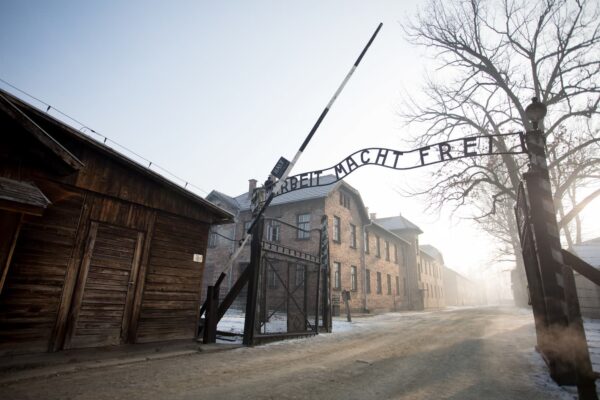
The gate-the iconic inscription “Arbeit Macht Frei”

ID 41362760 | Auschwitz © Danilo Mongiello | Dreamstime.com
The first camp where this inscription appeared was Dachau, but soon it was stamped on the gates of other sites as well.
“Arbeit Macht Frei” translated means “work makes you free,” was originally taken as a motto since it embodied the intentions of the camp, which was to “correct” the misbehavior of some German citizens.
In the 1930s, some disciplinary customs of the Prussian army were imported into the camps, such as the order of prisoners’ uniforms, the obligation of absolute precision in making their beds, or the use of music to mark the rhythm of certain phases of the day as per military practice.
These customs became proper to the camp; however, with the arrival of Jews and Slavs, considered by the Nazis to be “inferior races,” the purpose of “correcting” the prisoner was dropped.
The writing, however, remained, even in camps built as early as 1940 such as Auschwitz.
A curiosity: the inscription was forged by a Polish prisoner who was a blacksmith by trade, obviously in a coercive manner.
The man, to emphasize his dissent, decided to forge the letter “B” of the word “Arbeit” backwards.
It was a gesture destined to take on a strong symbolic value: suffice it to say that the fact is represented by a memorial statue placed in front of the European Parliament building in 2014.
Block 4 – The Extermination

Entrance to Block 4, Auschwitz – Photo ID 156200040 © Lester Riley | Dreamstime.com
Block 4 consists of six halls. This is where Poles, foreigners and later Jews from all over Europe arrived.
In the first room you can see a map showing the places from which the convoys arrived.
Next it is possible to look at photocopies of German death records: this is where Jews, Slavs, Sinti, political opponents and others found death, whether by summary executions, experiments, or from hardship.
The third room makes one reflect on the convoys that arrived at the camp: prisoners were crammed onto freight trains for journeys that lasted up to 10 days.
Under these conditions, the elderly and children often died already during the journey.
Of those who remained, camp doctors judged those skilled at work to be interned, while the others were sent directly to the gas chambers.
According to Rudolf Höß, the Auschwitz commandant, about 70-75 percent of the internees were taken to the gas chambers.
As you continue your tour of Block 4, you will be able to see three photographs secretly taken by an inmate depicting women being led to the gas chambers and the cremation at the stake of some of the corpses.
The Nazis exterminated their victims through Ziklon B gas: after the liberation of the camp, many canisters were found, some empty while others were ready to be used.
Also in this block you will be able to see a trellis woven with human hair: when the Soviets arrived, in fact, bags full of hair belonging to the inmates were found.
German firms were in fact producing pylons with human hair, and upon analysis, traces of prussic acid (that contained in Ziklon B gas) were found.
The inmates’ gold teeth were melted down and sent to the SS Central Sanitary Office while the human ashes were used as fertilizer.
In the sixth room you can find some of the items confiscated from the deportees, such as brushes and shaving brushes.
Many of these were appropriated for personal use by SS members, but despite this, the camp storerooms were always full.
Shortly before the arrival of the Soviets, the Germans tried to erase the trail by shipping many valuables and setting fire to the warehouses; despite this, thousands of brushes, clothes, shoes, glasses and more were found.
Block 5 – The evidence of the crime

Glasses of prisoners in Auschwitz concentration camp – Photo ID 274351760 © Sergii Figurnyi | Dreamstime.com
Here you can see for yourself various items seized from deportees: glasses, suitcases, shoes, etc.
They were snatched from prisoners as soon as they arrived at the camp in a view of brutalizing their humanity: stripped and deprived of all possessions, even their names were erased, replaced by an identifying number stamped on their skin.
Block 6 – The life of the prisoner

Entrance to Block 6, Auschwitz – Photo ID 37975633 © Vladiczech | Dreamstime.com
Materials were collected in this block to show visitors how the inmates lived inside the camp.
The exhibits include documents, photos, and paintings.
The camp director gruesomely explained to the victims that the only way out would be through the crematoria. The deportees suffered this harassment continuously: from the moment they arrived, they were stripped of all possessions and shaved.
Then they were marked with a number, and then photographed in three different positions: some of these pictures are visible in this block.
Each prisoner was marked with a different colored triangle according to the type of crime committed, and the uniforms provided to the prisoners were insufficient to shelter them from the cold.
In addition, the linen was changed after weeks, sometimes months, often causing outbreaks of infectious diseases, in view, also, of the state of malnutrition and the inhuman work rhythms.
On display in Block 6 are photographs taken during the liberation of the camp in which female inmates can be seen weighing less than 30kg.
Continuing your visit, you will see a series of artworks by artists who have tried to restore what camp life was like.
For example, you can see the works “Collecting Spilled Soup” or “Returning from Work.”
Finally, Room 4 in Block 6 is dedicated to the children deported to Auschwitz, who were entitled to the same treatment as adults.
Most of them, in fact, died in the gas chambers, while some were exploited for gruesome scientific experiments, such as infants or twins.
The others who passed the inhumane “selection” were forced into forced labor on a par with adults.
This room contains photos and clothing that belonged to the young Auschwitz prisoners.
Block 7 – Housing and sanitary conditions

Dormitories in Auschwitz – Photo ID 134865240 © Golasza | Dreamstime.com
Proceeding through Block 7 it will be possible to see the dormitories of the deportees.
Conditions were poor, as prisoners were forced to live crammed into unhealthy and cramped spaces.
Only later were three-story structures introduced, but without significant improvements in conditions: two prisoners slept on each level, covering themselves with light, threadbare and torn blankets.
The toilet facilities, which can be visited in Block 7, were also disastrous. If at Auschwitz I the inmates had masonry blocks at their disposal, at Birkenau the barracks lacked foundations, thus characterized by marshy ground that contributed to the spread of epidemics.
Block 10 – Mengele’s experiments

Block 10 where experiments on children were carried out – Photo ID 177849637 | Auschwitz © Wojciech Grabowski | Dreamstime.com
SS doctor, Josef Mengele conducted atrocious experiments on prisoners who often died as a result; sometimes death was the very intended result of the experiment.
Among the atrocities committed, Mengele conducted sterilization tests, injection of diseases to study their effects, killing and dissection of corpses for research.
He also conducted a personal study for the purpose of scientific accreditation: he investigated how genes develop into specific physical and psychological traits.
Mengele sought to confirm the Nazi theory of the existence of “superior and inferior races” by looking for biochemical markers indicating such a difference.
He mainly studied two ethnic groups, Roma and Jews, but also pairs of twins and people with congenital abnormalities: the camp doctor injected them with various substances and studied their side effects, at other times he killed the victims to study their anatomy.
Finally, he also conducted perverse experiments on children, operating on their spines, injecting substances into their eyes, inserting pins into the heads of the little prisoners, and many other pseudo-medical research more akin to torture.
The Wall of Death

The Wall of Death, Auschwitz – Photo ID 170944763 © Bruno Coelho | Dreamstime.com
Between Block 10 and 11 you will be able to see a courtyard fenced off on both sides by a high wall sadly known as “the Wall of Death.”
Against it, in fact, thousands of prisoners were shot by the SS.
In addition, in the courtyard of Block 11, camp inmates were also tortured through floggings or the punishment of the stake, which consisted of tying the victim’s hands behind his back and then hanging him from a pole.
The motives behind such harassment were often futile, such as an accusation of stealing an apple, an excessively slow pace of work, behavior not appropriate for the camp, and failure to report an escape attempt by a fellow barrackmate.
Block 11 – The Block of Death

Entrance to Block 11 – Photo ID 169602423 © Oksana Sotnykova | Dreamstime.com
The first room in Block 11 was where the SS stood guard. In the other rooms were the prisoners awaiting the sentences of the special court coming from Katowice.
Needless to say, in most cases, it provided for the execution of prisoners right at the “wall of death.”
In the last room you can admire some paintings by a former prisoner depicting the special court, dungeons and executions.
It was here, then, that inmates were punished for practically everything, sometimes just by the decision of one of the SS: for example, if he thought the prisoner was working too slowly.
Another important part of Block 11 is the dungeons: it was here where mass killings with the gas later used in the gas chambers were first tried.
Later cells were placed here where prisoners accused of transgressing the rules or even members of the population blamed for helping prisoners escape were locked up.
During your visit you will see for yourself three different types of cells.
Almost all of them were ordinary cells, but there are some special ones such as number 18 where those sentenced to death by starvation were locked up.
Another cell sadly more famous than the others is number 20, a dungeon where deaths from lack of oxygen occurred.
Or #22 where inmates were locked up in small bunkers measuring 90 x 90 cm.
The gas chamber and crematorium
Auschwitz crematoria – Photo ID 90458246 | Auschwitz © Adwo | Dreamstime.com
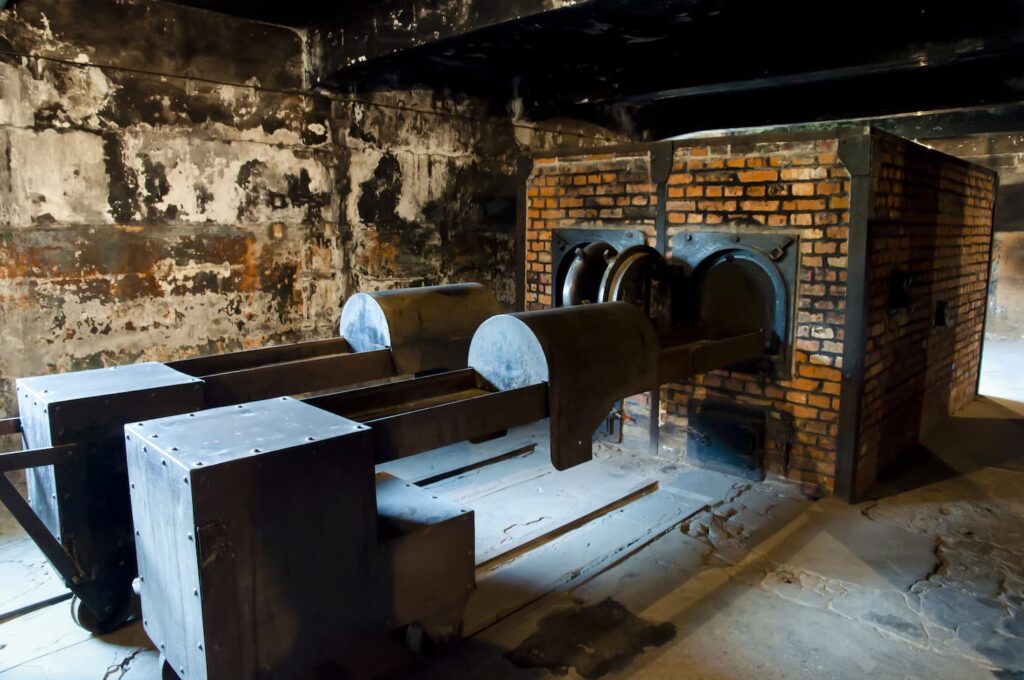
Outside the camp compound we find the crematorium.
In front of its entrance was the Gestapo barracks while we now find the gallows used to execute the camp’s first commandant Rudolf Höß following the 1947 sentence.
Auschwitz gas chamber: Photo ID 84296726 | Auschwitz © Nortophoto | Dreamstime.com
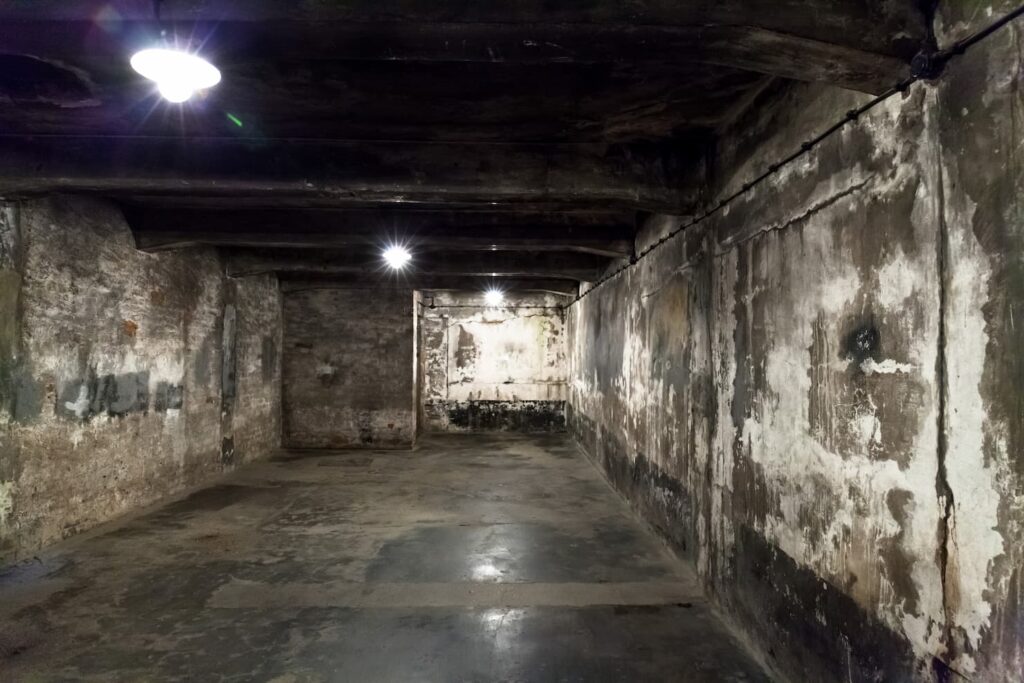
The crematorium was equipped with a morgue that was converted into a temporary gas chamber since it was the largest room.
The crematorium was equipped with three ovens, each of which was capable of burning three corpses at once.
Do-it-yourself Auschwitz tour: how to get to Birkenau from Auschwitz I
Auschwitz II – Birkenau is located about 3 km from the other camp, in the area of the small village of Brzezinka.
If you wish, you can also make the move on your own on foot (especially in the milder summer months), but I recommend using the free shuttle service.
Between April and October, you can count on a departure every 15 minutes, and in the other half of the year on a departure every 30 minutes
Short Guide to Auschwitz II – Birkenau
A camp of about 175 hectares in area, more than three hundred barracks were built here, although only 22 wooden and 45 masonry barracks remain.
Hygienic conditions in this camp were also disastrous, plus the problem of lack of water must be considered.
Here you will be able to visit the remains of the crematoria and gas chambers, as well as the railway yard where the deportees arrived and underwent the terrible selection following which, depending on the outcome, they were taken either to the camp or to the gas chambers.
The buildings are not intact because the SS tried to eliminate traces of the atrocious extermination committed there.
The tracks and the Watchtower

Train to Auschwitz-Birkenau – Photo ID 313381457 | Auschwitz © Alexey Fedorenko | Dreamstime.com
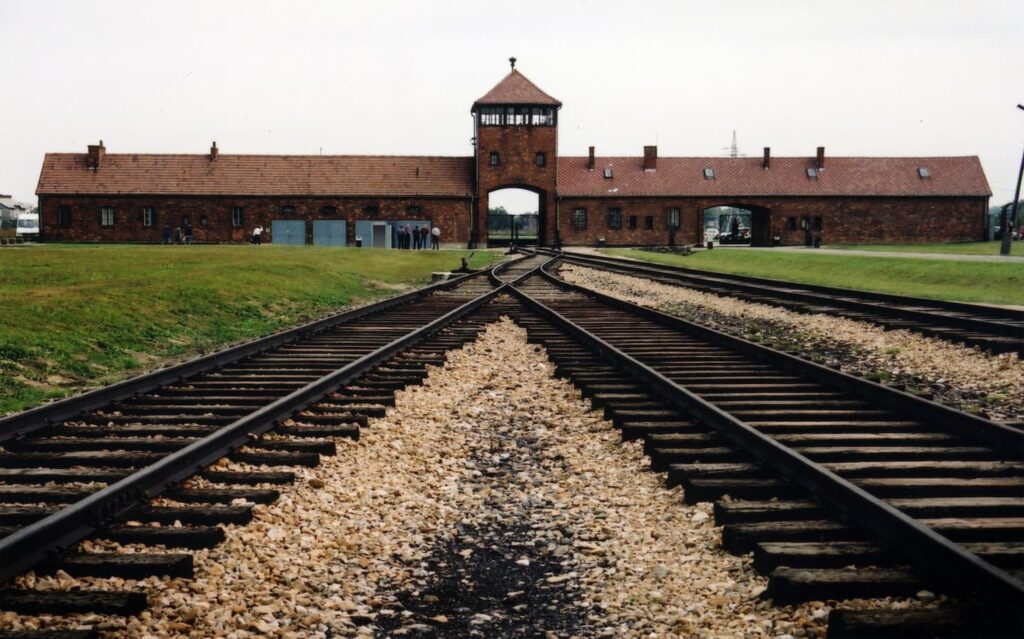
In this part of the museum-camp you can see with your own eyes the tracks on which the trains arrived with, inside, the deportees.
Conditions during the journey were so prohibitive that many inmates, especially the elderly and children, arrived at the camp already deceased.
Once they reached Birkenau, doctors would select prisoners who were able to work for internment, while those who were too weak were immediately sent to the gas chambers for elimination.
At the entrance to the camp you will also be able to see the imposing Watchtower overlooking the tracks.
The barracks

Some blocks of Birkenau – Photo ID 68724935 © Michael Paschos | Dreamstime.com
As mentioned earlier, only a portion of the barracks have been preserved in their original state.
The masonry barracks, located on the left side of the tracks, were built directly on the ground, which was easily muddy and swampy, unhealthy to the point that it often contributed to the many epidemics spread in the camp.
These unhealthy environments, often frequented by rats, housed the bunks on which the inmates slept, which were often made from rotten straw.
The wooden barracks, on the other hand, located on the right side of the tracks, were originally stables, which were later converted into housing for about 400 inmates.
The ruins of the gas chambers and crematoria
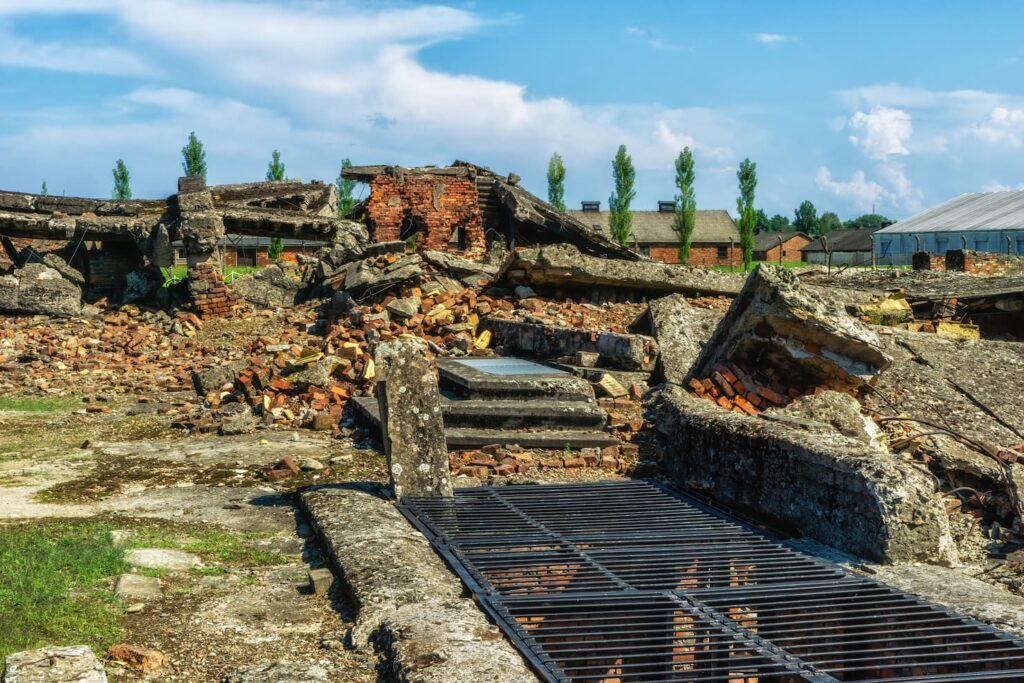
Ruins of a destroyed gas chamber in Birkenau – Photo ID 271443977 | Auschwitz © Atosan | Dreamstime.com
As you have already read, with the arrival of the Soviets, the Nazis tried to eliminate the traces of the extermination perpetrated against the Jews by destroying the facilities.
Therefore, the ruins of the gas chambers and the five crematoria remain at Birkenau.
In fact, the fourth oven was already partially destroyed during the prisoners’ uprising in October ’44.
Between the second and third ovens you will be able to admire the International Monument in Memory of the Victims of Nazi-Fascism in Auschwitz, unveiled in 1967.
Visiting Auschwitz on your own: Frequently Asked Questions
The ticket is free, but you must necessarily remember to book it in advance. However, we recommend that you book priority access and/or the expert language escort (paid services).
Kraków is about 70 km from Oświęcim, the town that is home to Auschwitz.
The duration varies depending on the means of transportation chosen and the city of departure. The nearest major city is Katowice, from which you can arrive by a drive of about 45 minutes. From Krakow it is about an hour and 20 minutes. Warsaw, on the other hand, is a bit further away, and from the center you can reach the museum-campus after a drive of about three hours and twenty minutes. If you travel by train or bus, you will have to reach Krakow and then continue to the camp.
You will be able to book your visit on the official Auschwitz website: just select “Visiting” on the home page of the site and then choose “Reservation.” From here you will be able to book simple entry free of charge, but remember that it is recommended to book priority access and the expert guide in English.
Complete visit to Auschwitz-Birkenau on your own: conclusions
Here we have come to the end of this article of ours. As you have seen, visiting the Auschwitz museum-camp is a very important opportunity for personal growth and reflection.
You will be able to see with your own eyes the sad places where the holocaust was carried out: the famous inscription at the entrance to the camp, the terrible inmate barracks, the crematoria and gas chambers.
You will also be able to visit the tracks where SS doctors sorted the deportees, the personal belongings of the victims, and even paintings by prisoner artists.
We also looked at how best to dress, camp schedules, and how to book tickets and a guide in English to best visit the museum-camp.
Finally, I have answered the most frequently asked questions, but should you have any other concerns, below you will find a section where you can leave a comment.
And, remember, don’t forget that in order to visit Auschwitz-Birkenau on your own we strongly recommend that you book your skip-the-line ticket: this is the only way you will get priority access to avoid waiting at the camp entrance.
Also consider the most important tip, which is to also reserve a guided tour: this is the only way to make the most of your visit and not risk missing even one historical curiosity.
Only in this way can you have a truly complete and unforgettable experience, because, as Primo Levi said, “If understanding is impossible, knowing is necessary.”
Auschwitz-Birkenau: Self-Guided Tour + Transport
Buy online. Choose the time of your choice. Visit the prisoner barracks, infamous gas chambers and crematoria on your own.
You can cancel for free up to the day before your visit.
Cover photo: ID 189608250 | Auschwitz © Tuayai | Dreamstime.com